
OpenAI’s Micro Keypad: A Niche Gimmick or a Signal of Deeper Ambition?
- Artificial Intelligence
Arjun Vedanta
- 0
- 5 minutes read
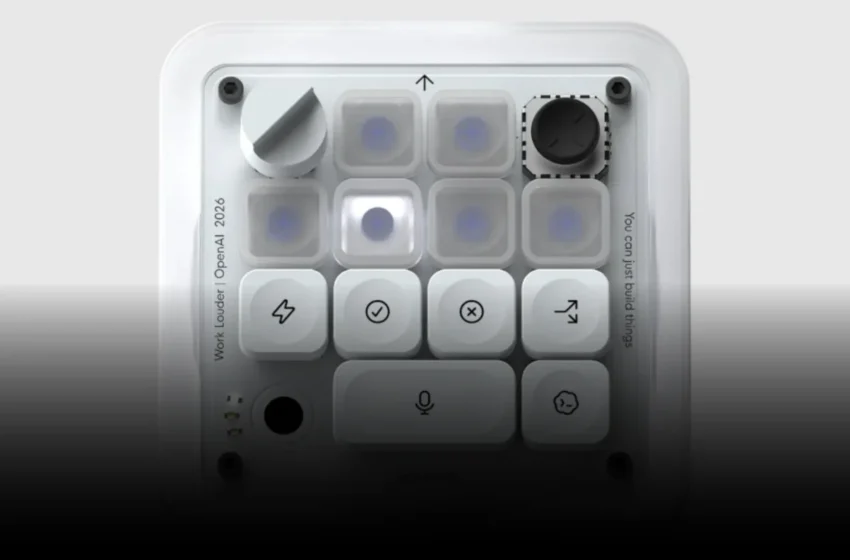
The $230 price tag for OpenAI’s new Micro keypad feels less like a functional accessory and more like a carefully placed marker in a rapidly escalating conflict. This isn’t merely about a novelty peripheral for ChatGPT power users; it’s a telling, if clumsy, overture in OpenAI’s burgeoning effort to control not just the software, but the physical interface of artificial intelligence itself. For observers outside Silicon Valley’s immediate orbit, this small, “Apple-coded” device offers a glimpse into a much larger strategic play: the quiet but determined push by the leading AI lab to forge its own proprietary ecosystem, sidestepping the gatekeepers of traditional consumer electronics.
The Curious Case of the “Artisanal” AI Controller
OpenAI’s collaboration with Work Louder yielded the Micro, a six-agent, six-command keypad designed to streamline interaction with ChatGPT and its coding tool, Codex. The device offers intuitive features like a dedicated voice dictation button and customizable keys, promising to assign specific AI sessions for quicker toggling between projects. It connects via Bluetooth or USB, and its packaging, described as “immaculate white” and “sleek,” immediately evokes Apple’s signature aesthetic — a detail not lost on anyone tracking the industry. Yet, the initial reception from the very “code monkeys” it purports to serve has been lukewarm at best.
It’s a perplexing scenario: a company defining the bleeding edge of software pushing out hardware that elicits Reddit comments like “a prank and not a real product,” and reviews that call its $230 price tag hard to justify against cheaper, DIY alternatives. “OpenAI’s expensive macropad feels engineered to piss me off specifically,” one independent outlet declared. The learning curve, the need to memorize color-coded key statuses (white for idle, blue for thinking, green for complete, red for error), and the fundamental question of whether it’s genuinely more efficient than a mouse and keyboard, all point to a device that struggles to define its immediate utility. This is the sharpest observation: The true purpose of the Micro isn’t to revolutionize my workflow; it’s to plant a flag for OpenAI’s presence in your physical space.
Beyond the Clicky Buttons: A Play for Ecosystem Control
To understand the Micro, one must look past its immediate functionality and towards the broader machinations of the AI industry. The keypad’s launch isn’t an isolated event; it arrives on the heels of a public trade theft lawsuit from Apple and alongside whispers of an OpenAI-developed smart home device, reportedly engineered by former Apple talent. This pattern reveals a clear incentive: OpenAI is actively trying to expand its influence beyond cloud-based services and into the burgeoning market of consumer electronics, directly challenging established hardware giants.
For years, Apple and Google have reigned supreme by controlling the devices through which we access the digital world. They dictate app store policies, hardware specifications, and ultimately, user experience. As artificial intelligence shifts from a feature to the operating system itself, the battleground moves to the interface. OpenAI, a company primarily focused on large language models and AI agents, cannot afford to be merely a software provider beholden to hardware platforms it doesn’t control. The Micro, for all its niche appeal, is a calculated attempt to assert a proprietary vision for human-computer interaction in the AI age, carving out a direct physical connection to its services. It’s not about selling keypads; it’s about establishing a precedent for OpenAI-branded interaction points.
The Unspoken War for the AI Interface
The true structural implication of the Micro keypad is not its ergonomic design or its customizability, but its symbolic value in the looming war for the default AI interface. If artificial intelligence becomes the primary way we interact with technology, then the physical devices that mediate that interaction will hold immense power. This isn’t merely about developer tools; it’s about shaping the future of consumer electronics.
By introducing hardware, however rudimentary, OpenAI signals its intent to control the entire stack — from the foundational models to the physical buttons you press. It wants its AI agents to have direct, dedicated input mechanisms, not just live within browser tabs or generic applications. This is a strategic move to define how we touch, speak to, and command AI, thereby influencing user habits and solidifying its position as the ultimate AI ecosystem provider. The fight is for who controls the ‘send’ button, the ‘dictation’ button – the very conduits of our digital will. Micro, despite its current limitations, is less a product and more a manifesto: OpenAI intends to be at the controls, both virtually and physically.
This small, expensive peripheral, with its limited adoption and specific use case, might seem like a misstep. But consider it less as a finished product and more as a proof-of-concept for a much larger ambition. It’s a deliberate, if early, attempt to bridge the gap between abstract AI capabilities and tangible physical interaction, ensuring OpenAI isn’t just a brain in the cloud, but a hand in the hardware.
