
Solar Vortices: A Century-Old Puzzle Reframes Our Geomagnetic Vulnerability
- Space
Arjun Vedanta
- 0
- 5 minutes read
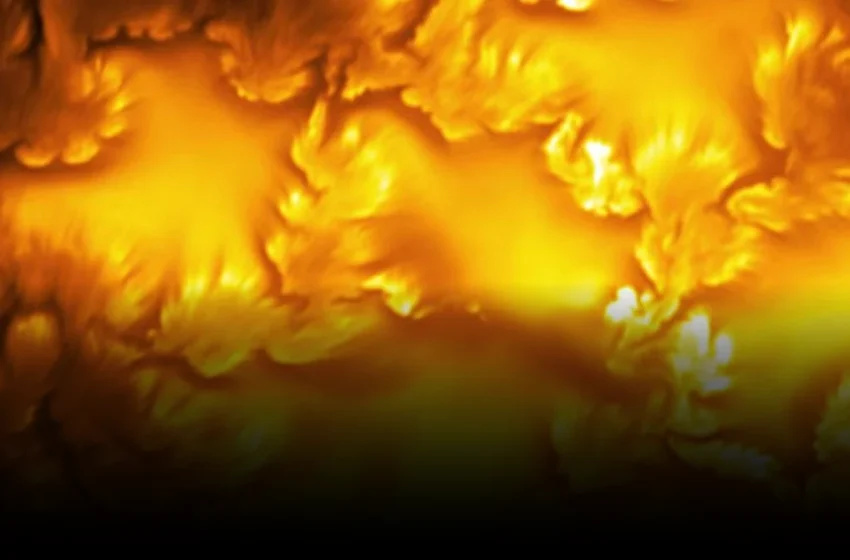
The Visible Unseen: Beneath the Solar Skin
The latest image from the Daniel K. Inouye Solar Telescope, capturing intricate plasma vortices on the sun’s surface, is not just a scientific triumph; it is a stark, high-resolution reminder of our persistent inability to predict the very phenomena that threaten our terrestrial infrastructure. For decades, researchers theorized that the sun’s fiery expanse must harbor these tiny, ephemeral swirls, born from the friction of plasma streams moving at different velocities – a physical phenomenon known as Kelvin-Helmholtz instability, first predicted over a century ago. Now, with unprecedented clarity, the telescope at Haleakalā volcano in Hawaii has delivered definitive visual proof.
This isn’t another stunning ultraviolet snapshot; this is visible light, revealing a landscape reminiscent of organic folds and petals. Previous visible-light instruments provided a deceptively smooth view, masking the chaotic micro-dynamics beneath. The Inouye telescope, however, has pierced that veil, showing vortices barely a few dozen kilometers in diameter, forming and dissolving constantly across an area roughly the Earth’s radius. This isn’t about seeing something *new* on the sun; it’s about finally *seeing* what we already knew must be there, in exquisite detail, a testament to advancing optical resolution in plasma physics.
Understanding these small-scale instabilities is not merely an academic exercise. The incentive behind this continuous, multi-billion-dollar investment in solar observation is to bridge the gap between theoretical models of the sun’s behavior and the practical, actionable foresight we desperately need. These images justify the massive engineering feats behind instruments like the Daniel K. Inouye Solar Telescope, framing the discoveries as essential steps toward safeguarding our increasingly fragile digital world.
From Micro-Turbulence to Macro-Threats
The core significance of these newly observed micro-vortices lies in their potential to explain the larger, more destructive processes originating from our star. Scientists believe these small-scale dynamics play a crucial role in how the sun transfers energy into its outer regions and, critically, how it heats the solar corona. The corona, a superheated atmospheric layer, is the progenitor of coronal mass ejections (CMEs) – titanic bursts of plasma and magnetic field that, when directed towards Earth, are responsible for geomagnetic storms.
These storms are not merely pretty auroras. They are capable of unleashing electromagnetic pulses that induce currents in long conductors, damaging power grids, disrupting satellite communications, and corrupting sensitive electronic systems globally. The scientific community has long grappled with the mechanisms behind coronal heating and CME initiation, and these visible-light observations offer a new data stream to refine computational models of the heliosphere, potentially illuminating the complex pathways of energy flux from the sun’s surface to interplanetary space.
Yet, here is the contrarian observation: for all the awe-inspiring detail of a few dozen kilometers, the scale of a destructive CME is still gargantuan, spanning millions of kilometers and traveling at speeds that offer precious little warning. Seeing a clearer picture of tiny plasma disturbances is a monumental achievement in plasma physics, but it does not, by itself, translate to a reliable, long-range forecast of a Carrington Event-level storm. We are still observing the intricate dance *on* the bomb, rather than predicting precisely when and how it will detonate.
Our Fragile Shield: Predicting the Unpredictable
The Silicon Valley narrative often fixates on breakthroughs in AI or quantum computing, overlooking the foundational, existential threats posed by our immediate cosmic neighborhood. For all our technological sophistication, our modern, interconnected world remains exquisitely vulnerable to space weather. A significant geomagnetic storm could cause cascading failures across global power grids, communication networks, and GPS-dependent systems, leading to economic disruption measured in trillions and a societal rollback that would make a typical internet outage seem quaint.
While this unprecedented resolution will undoubtedly advance our understanding of fundamental solar processes, the leap from observing Kelvin-Helmholtz instabilities to accurately predicting the trajectory and intensity of a killer CME remains immense. The data will feed into more sophisticated simulations, of course, but the sheer complexity of solar plasma dynamics means that adding more variables, even incredibly detailed ones, doesn’t always simplify the predictive challenge. It often reveals just how much more we still don’t know, underscoring the limitations of even the most powerful telescopes.
Ultimately, the stunning visual of the sun’s micro-vortices highlights a profound paradox: our capacity for granular observation is expanding rapidly, yet our ability to preempt large-scale, high-impact space weather events—which these observations are meant to help us predict—remains fundamentally limited. It serves as a potent reminder that our most advanced technology, the very fabric of our digitized civilization, is built on a foundation perpetually exposed to the unpredictable, violent whims of a star we are only just beginning to truly see.
