
The Papier-Mâché Protest: Why AI’s Wealth Chasm Worries the World, Not Just San Francisco
- Artificial Intelligence
Arjun Vedanta
- 0
- 5 minutes read
The Cost of AI: Beyond Copyright and Into Capital
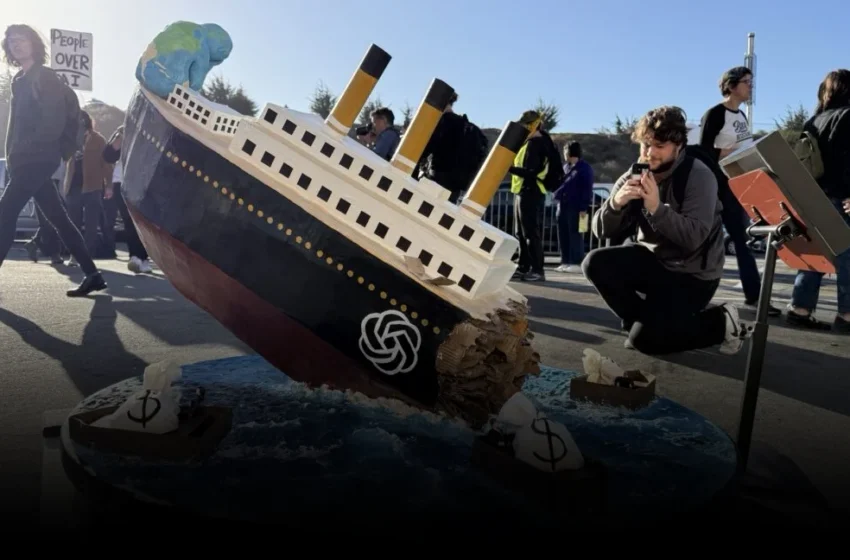
A 5-foot-tall papier-mâché sculpture, depicting OpenAI leaders fleeing a sinking ship laden with cash, appeared at a developer event in San Francisco this week. Crafted over five days by artists from Berkeley-based Odd Friend Studio, “What Iceberg?” isn’t just local street theater; it’s a stark, visceral representation of a rapidly widening chasm between the tech industry’s narrative of AI progress and the mounting global anxiety over its economic and ethical implications.
The artists’ direct accusation – that “OpenAI’s leaders and investors escaping a sinking ship with unimaginable wealth, while everyone else is left to face the cost of AI” – cuts through the usual Silicon Valley discourse. This isn’t merely about job displacement or abstract risks; it’s a pointed critique of concentrated power and a perceived lack of accountability, framed through the lens of vast wealth accumulation at one end and an unquantified societal bill at the other.
From the vantage point of London or Singapore, this kind of protest resonates differently than it might within the Bay Area bubble, where such demonstrations can often be dismissed as fringe activism or public relations headaches. Globally, particularly across Europe and parts of Asia, the concerns surrounding *generative AI* development are less about a distant sci-fi future and more about very immediate, tangible issues: intellectual property, data sovereignty, labor market disruption, and crucially, who reaps the immense profits while society bears the unforeseen burdens. This installation brings that abstract, systemic concern down to a painfully concrete visual.
The Incentive Divide: Narrative vs. Reckoning
This protest surfaces at a critical juncture for OpenAI and its peers. The imperative for companies like OpenAI is to maintain an image of innovation, democratizing access, and solving grand challenges, all while accelerating user adoption and securing ever-larger rounds of *venture capital*. Developer conferences are battlegrounds for mindshare, essential for embedding platforms into the digital infrastructure. A public display that explicitly calls out “unimaginable wealth” and societal “costs” directly undermines this carefully curated narrative, forcing a reckoning with *tech ethics* that the industry would prefer to defer until profitability is unassailable.
Conversely, the artists, like Kevin, are driven by an entirely different incentive: moral conviction. Their medium—simple papier-mâché, cardboard, and paint—stands in stark contrast to the billions flowing into AI labs. They benefit from raising awareness, from giving visual form to a pervasive, if often unspoken, fear among broader publics. It’s a call for *regulatory oversight* and transparency before these powerful systems entrench existing economic inequalities and create new ones, a plea for a more equitable distribution of AI’s burgeoning value and its inevitable costs.
Yet, here is the sharpest observation: while Odd Friend Studio crafts their critique with rudimentary materials, the very AI models they protest are rapidly transforming creative industries globally. The irony is palpable: artists are forced to protest in traditional ways against technologies that threaten to redefine the very nature of art and creation itself. Can a sculpture, however poignant, truly alter the trajectory of corporate titans backed by unprecedented capital? The current trajectory suggests the iceberg the artists depict may not be approaching, but rather, is already the very water they’re trying to swim in.
Beyond the Bay: AI’s Global Capitalist Critique
“What Iceberg?” isn’t just about OpenAI; it’s a symbolic mirror held up to Google DeepMind, Anthropic, Meta, and indeed, any entity aggressively pursuing AI dominance. The public’s apprehension isn’t confined to fears of AI sentience; it increasingly encompasses a profound skepticism regarding its human architects, questioning their unchecked power and the opaque capitalist structures underpinning their development.
This is where the international perspective is vital. While Silicon Valley debates feature fine-grained arguments about dataset provenance or model alignment, the wider world often sees a monolithic industry accelerating away from collective control. The critique of wealth concentration within the AI sector points towards a broader questioning of contemporary capitalism itself, particularly as it intersects with rapidly advancing, general-purpose technologies. The promise of *open source* principles, once central to much of tech, seems increasingly quaint when confronted with the proprietary, black-box nature of today’s leading AI models.
The protest, small as it was in the grand scheme of a developer conference, serves as a crucial signal. The global conversation about AI’s “costs” is escalating, shifting from abstract, philosophical debates to concrete socio-economic impacts. It’s a clear indication that the world is beginning to demand answers not just about what AI can do, but for whom, and at whose ultimate expense.
