
Unseen Solar Dynamics: New Telescope Exposes Ubiquitous Vortexes, Reshaping Fundamental Physics
- Space
Arjun Vedanta
- 0
- 5 minutes read
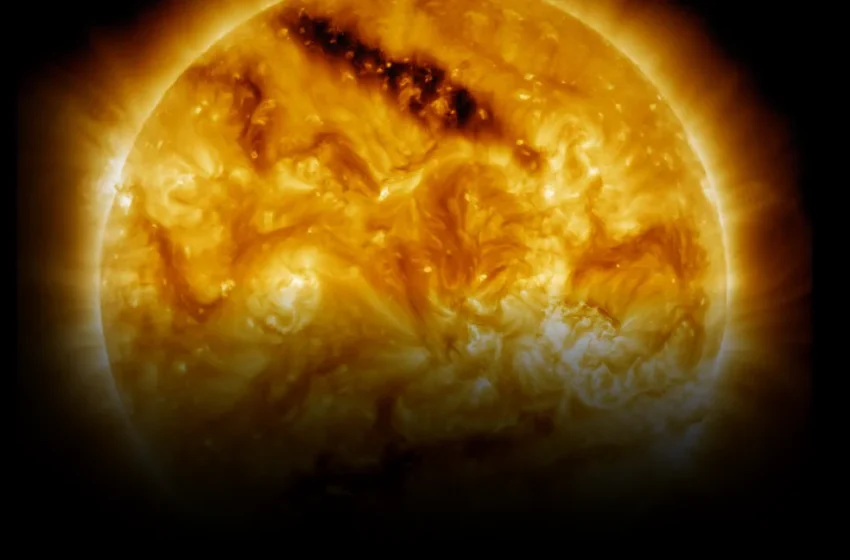
The Solar Surface: A Century of Unseen Agitation
For more than 150 years, physicists have understood the Kelvin-Helmholtz instability: the fundamental principle where differential fluid speeds create buckling, curling, and eventually, rolling vortexes. This foundational concept explains everything from wind-driven ripples on a pond to the intricate shear clouds forming in the sky. It has long been theorized that this same chaotic dance must occur within the superheated plasma on the Sun’s surface, yet direct observational proof remained stubbornly out of reach.
Now, a team led by David Kuridze and Friedrich Wöger at the National Solar Observatory has delivered that proof, using the gargantuan Daniel K. Inouye Solar Telescope (DKIST). Their findings confirm that these plasma whirlpools are not just theoretical curiosities, but a ubiquitous feature across the Sun, fundamentally altering our understanding of how energy, mass, and magnetic fields propagate through its atmosphere. This isn’t merely an incremental scientific update; it’s a profound revelation about the dynamic star that sustains our solar system, enabled by a colossal technological leap.
The critical barrier wasn’t a lack of theory or imagination, but pure resolution. These solar vortexes are extraordinarily small, far below the visual acuity of any solar telescope built prior to this generation. Instruments with mirrors smaller than two meters simply could not resolve them, leaving a gaping blind spot in heliophysics for decades. The problem was not intellectual, but quite literally, one of seeing.
The Colossus of Maunakea: A Testbed for Terrestrial Optics
The Daniel K. Inouye Solar Telescope, commissioned by the US National Science Foundation and entering its operational phase in November 2021, represents a singular achievement in optical engineering. Its four-meter primary mirror, the largest dedicated to solar observation globally, is the technological linchpin behind this discovery. This isn’t a story of elegant algorithms or clever software; it’s a brute-force victory of scale and precision in hardware, a testament to the decades-long commitment required to push the very boundaries of observational astronomy.
From a global tech perspective, this is precisely the kind of infrastructure project that US-centric tech reporting often overlooks, fixated as it is on the next app or AI model. Yet, the engineering challenges behind DKIST – from maintaining perfect optical alignment under extreme thermal loads to managing gigabytes of data per second – are as sophisticated, if not more so, than those faced by any hyperscale data center or semiconductor fab. This telescope is a global asset, a triumph of international collaboration and engineering prowess, despite its American funding.
It’s telling that in an era obsessed with immediate gratification from AI breakthroughs and quantum computing hype, some of the most profound scientific revelations still hinge on decades-long engineering sagas, exposing an uncomfortable truth about how fundamental research often proceeds at a glacial pace compared to iterative commercial development. While venture capitalists pour billions into accelerating digital transformation, the cosmos continues to yield its secrets on its own demanding schedule, dictated by the limits of our physical instrumentation.
Beyond Mere Observation: Reshaping Solar Physics Models
The confirmed ubiquity of Kelvin-Helmholtz instabilities isn’t just a fascinating image; it provides a crucial missing piece in the complex puzzle of solar dynamics. These newly visible vortexes are now understood to play a significant role in the transport of heat, mass, and magnetic energy within the Sun’s turbulent atmosphere. This fundamentally challenges existing models that have for generations relied on theoretical approximations or extrapolated data from lower-resolution observations.
Understanding these processes is far from academic esoterica. The Sun’s activity directly impacts space weather, influencing everything from satellite communication and GPS accuracy to power grid stability on Earth. More accurate models of solar plasma behavior, derived from these precise observations, are indispensable for better forecasting these terrestrial effects. The underlying incentive for massive national investments in facilities like DKIST isn’t just pure scientific curiosity; it’s also about national prestige in cutting-edge research and the cultivation of engineering talent that, while focused on the cosmos, generates transferable knowledge for diverse technological applications.
This breakthrough underscores a vital lesson: true innovation isn’t solely about disruption and speed. It often involves immense, patient investment in foundational infrastructure that allows us to perceive reality with unprecedented clarity. The Daniel K. Inouye Solar Telescope serves as a monumental reminder that even in the age of rapid digital transformation, our understanding of the universe’s most basic physical laws remains profoundly incomplete, awaiting the next generation of instruments to peel back another layer of the unknown.
