
Why Washington’s Green Pool Foreshadows Deeper Governance Failure
- Tech
Arjun Vedanta
- 0
- 6 minutes read
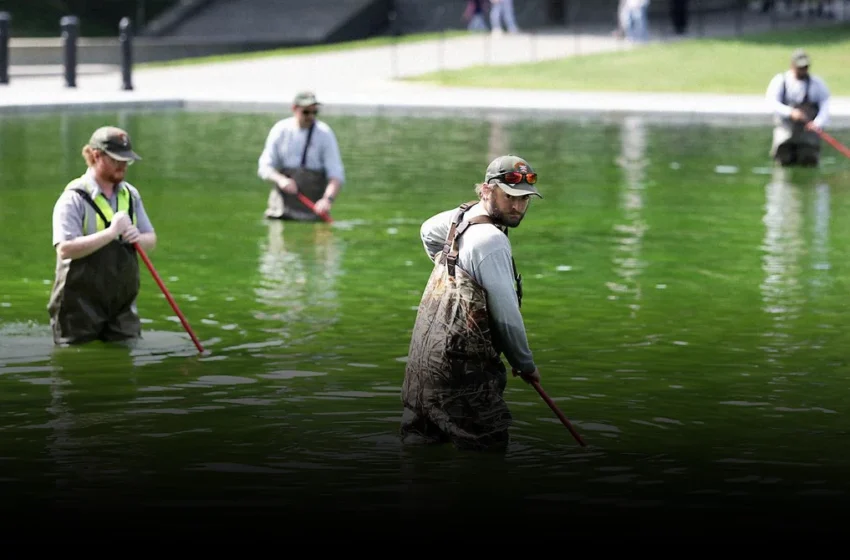
The Green Screen of American Infrastructure
Washington’s iconic Reflecting Pool is green again, not the “American flag blue” promised by a $14 million renovation that concluded just days before the algae bloom took hold. While the world grapples with negotiating the very foundations of advanced AI models like Anthropic’s Fable 5, or brokering delicate ceasefires in geopolitical hotspots, the American capital is busy deploying hydrogen peroxide and “nanobubble ozone technology” to combat a relatively simple biological problem on its most prominent public stage. This stark contrast isn’t just an embarrassing hiccup; it’s a visible symptom of a profound, systemic dysfunction in how a developed nation approaches both its tangible assets and its most critical, albeit less visible, challenges.
The problem is not new. A prior, larger $34 million renovation under the Obama administration also faced algae issues, a fact cynically twisted by a spokesperson for the current Interior Department to deflect blame, calling those efforts “broken and disgusting days later.” But the recent $14 million effort, completed by a company with ties to former President Donald Trump’s golf courses and awarded without a competitive bid, failed to even last a week before the green slime returned. We are told by an Interior Department spokesperson that “residual algae from the supply lines” were partly to blame, an explanation that stretches credulity when discussing a project of this scale and cost.
The science is clear and unforgiving: “It’s just getting hotter, and these blooms are expanding globally,” states Hans Paerl, a former professor at the University of North Carolina’s Institute of Marine Sciences, noting that a “temperature effect” optimizes algae growth. Drawing water from the often-algae-filled Tidal Basin, combined with increasingly warm, stagnant conditions, creates “a perfect storm.” This isn’t rocket science; it’s basic environmental management. Yet, the persistent failure to integrate fundamental climate realities and sound hydrological practices into infrastructure planning speaks volumes about a deeper institutional blindness, or perhaps, indifference.
Performance Art and Public Works
The saga of the Reflecting Pool is less about engineering and more about political theater. The incentive for the Trump administration to frame this project as a swift, cost-effective triumph was obvious: to create a visible, easily understood “win” for public consumption, contrasting it with prior administrations’ efforts. The claim that his chosen company would complete repairs “in much less time, for much less money” now rings hollow, a textbook example of how superficial promises often dissolve when confronted with physical reality. This focus on performative action over sustainable outcomes is a recurring motif in public works across many Western nations, where ribbon-cutting events take precedence over long-term maintenance budgets and climate resilience strategies.
Why this particular fascination with a shallow body of water? Because it’s a tangible, highly visible symbol. Its “blueness” can be easily photographed and spun into a political narrative, unlike the intricate, often invisible work of securing critical infrastructure against cyber threats or crafting nuanced regulatory frameworks for rapidly advancing AI. This misplaced emphasis diverts national attention and resources from issues that genuinely shape the future but lack the immediate, photogenic impact. It’s a cheap trick, frankly, when the stakes are so much higher.
The continuous political finger-pointing — from Trump’s AI-generated images blaming Democrats for “neglecting” the pool to the Interior Department’s swift dismissal of the Obama administration’s previous efforts — illustrates a chronic inability to approach national infrastructure as a non-partisan, long-term challenge. Instead, it becomes a prop in an endless campaign cycle, each administration seeking to lay claim to a quick, shallow victory, only to blame the next for the inevitable reversion to reality.
The Unseen System Under Stress
The true cost of the green Reflecting Pool isn’t just the $14 million, or even the cumulative $48 million spent across administrations. It’s the opportunity cost. While the nation obsesses over a green puddle, the really hard problems — the structural implications of a warming planet on urban infrastructure, the looming questions of digital governance, and the urgent need for a coherent national strategy around artificial intelligence — remain under-addressed, if not entirely ignored. Silicon Valley reporters might focus on the “nanobubble ozone technology” as a clever gadget, but the real story is the underlying system that allows such an expensive, visible failure to occur repeatedly.
This episode serves as a powerful metaphor for America’s broader infrastructure debt and its political climate. The continuous struggle to keep a public pool blue, despite significant investment and advanced “solutions,” highlights a deeper vulnerability in national systems. It suggests a government that struggles with the basics—maintaining what it already has—while simultaneously facing unprecedented challenges in emerging fields. Consider the rapid advancements in AI: while the Interior Department tries to kill algae, the implications of Fable 5, or any comparable advanced AI model, on employment, national security, and individual rights are vastly more complex and demand a far more sophisticated, sustained governmental response than we currently observe.
For intelligent, skeptical readers who follow the daily churn of TechCrunch and Ars Technica, this isn’t just a story about a puddle. It’s about a nation’s capacity for effective governance. If we cannot reliably keep our most symbolic public works operational in the face of predictable environmental challenges, how can we expect to navigate the far more intricate and unpredictable waters of global technological disruption and climate adaptation? The answer is sobering: we cannot, not without a fundamental shift in political priorities and a serious commitment to genuine long-term planning, far beyond the next news cycle or election.
