
Beyond the Green Algae: The Deeper Crisis of Transparency at the Lincoln Memorial Pool
- Tech
Arjun Vedanta
- 0
- 5 minutes read
The Fog of Officialdom: Why Facts Drown in Public Projects
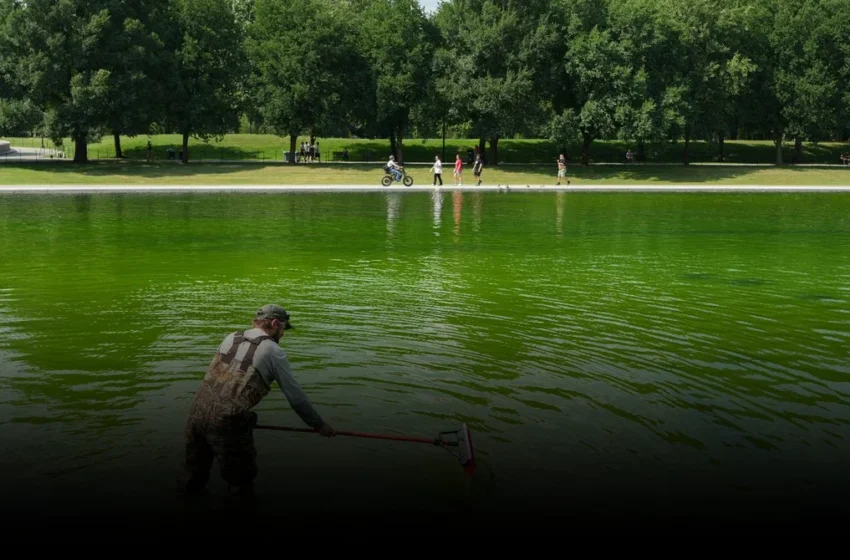
The Lincoln Memorial Reflecting Pool, a monument to American ideals, currently mirrors a far less flattering image: a murky reflection of official opacity. Following a renovation that President Donald Trump’s administration promised would deliver “American flag blue” water, the pool has instead become a canvas for green algae blooms and mysteriously peeling lining. This isn’t merely a maintenance failure; it’s a symptom of a deeper, more troubling trend where transparent governmental oversight on infrastructure projects seems to dissolve faster than chemicals in a troubled reservoir.
The core problem isn’t just the complex interplay of water chemistry and environmental engineering, though those are certainly confounding factors. Rather, it’s the calculated obfuscation by authorities that weaponizes technical ambiguity and political deflection to avoid accountability, effectively preventing a transparent diagnosis and resolution. This systemic issue leaves the public and experts alike grasping for fundamental information, illustrating a stark disconnect between public works and public trust.
“Vandalism” as a Political Alibi: Unpacking Official Narratives
Consider the official response: President Trump, without presenting any evidence, declared the pool would be drained and blamed “vandals” for the problems. This claim—a supposed “250-foot gash”—is the sharpest example of a political dodge, serving to divert attention from potential project mismanagement rather than offering an earnest assessment. It’s an old trick, but its deployment here, against the backdrop of a national landmark, is particularly jarring, inviting skepticism from anyone paying attention.
The incentive for such an unsubstantiated claim is clear: the administration faces a public relations debacle over a highly visible infrastructure project. By externalizing blame onto anonymous saboteurs, officials attempt to shield themselves from responsibility for what appears to be a systemic failure in planning, execution, or material selection. One wonders how a “250-foot gash” mysteriously eluded detection by US Park Police, who have reportedly been arresting people merely for touching the water.
Even expert voices, like YouTube’s “Swimming Pool Steve” Goodale, are left in the dark. Goodale, whose channel boasts nearly 91,000 subscribers, candidly admits, “There’s not enough information in terms of pictures, videos, water chemistry values.” He finds the vandalism narrative baffling, stating, “I can’t really get my head around the mechanism of vandalism that could cause this kind of damage.” This lack of transparent data isn’t incidental; it’s a deliberate information vacuum that allows official narratives to take precedence over factual inquiry.
The Technical Black Box: Nanobubblers and Unanswered Questions
The Department of Interior’s repeated insistence on “nanobubblers” as a solution further illustrates this pattern of technical jargon as a smokescreen. Nanobubbler technology, an ozone injection system, adds oxygen to water to suppress algae and control phosphorus release—the primary nutrient for algal growth. While a legitimate environmental engineering tool, its deployment is cited without critical context, such as current phosphate or nitrate levels, or details about the source water.
Goodale’s frustration is palpable. He highlights that simple water testing could reveal much: “The water that’s in the pool is really what matters here. Now that it’s in the pool, what’s the phosphate level? What’s the nitrate level? Those would be good things to know.” Yet, access for such basic diagnostics has reportedly been curtailed, with US Park Police making arrests. This creates a technical black box around a critical civic asset, where even basic transparency is denied, fostering distrust and impeding genuine solutions for public good.
The peeling lining itself, described by Goodale as an “oh, crap” moment, points to potential installation flaws. He explains that membrane systems require meticulous attention to “ambient conditions like rain, sun, humidity, moisture control in your substrate, thickness, evenness, and chemical compatibility.” If the material “hasn’t bonded to the substrate for any number of reasons, then ultimately, the entire system will fail.” The question isn’t just whether hydrogen peroxide contributed to the peeling, but whether fundamental errors in construction or material science were present from the outset.
Ultimately, the saga of the Reflecting Pool is a powerful reminder that complex public infrastructure projects demand rigorous, transparent accountability at every stage. When officials resort to political deflection and technical opacity, they not only betray public trust but also make it impossible to address the underlying issues effectively. This isn’t just about a green pool; it’s about the integrity of our governmental processes and the faith we place in their stewardship of national symbols and significant investments.
