
China’s Rocket Recovery: Geopolitical Launchpad, Not Just Tech Triumph
- Space
Arjun Vedanta
- 0
- 5 minutes read
Beyond the Catch: Strategic Location and Undisclosed Payloads
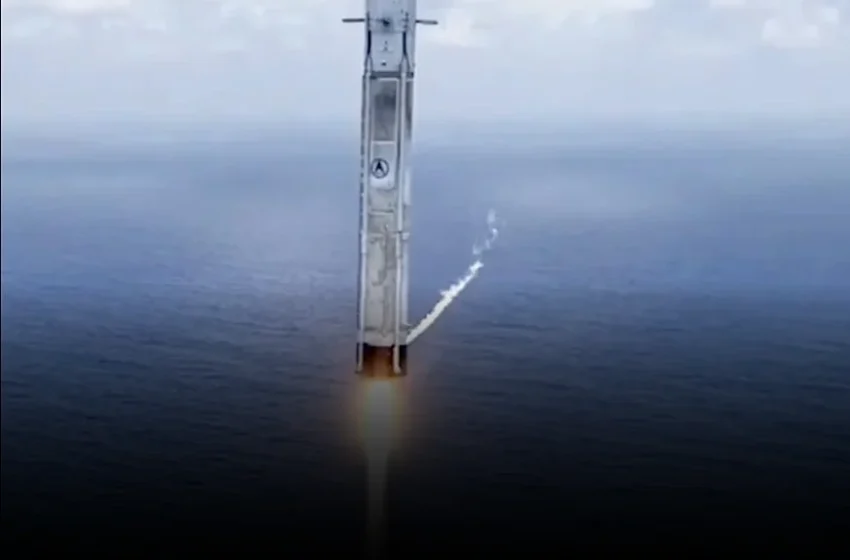
The specific detail of a rocket booster being recovered in the South China Sea, rather than an inland test range or a less contested international water, casts China’s latest space milestone in a starkly different light. While Western media focused on the ingenious method of catching a descending 63.6-meter Long March 10B booster with tensioned cables on an offshore vessel, the true significance lies in where and for what purpose this test was conducted.
This event, hailed as a “complete success” by Chinese officials, is not merely a technical achievement; it is a calculated geopolitical statement.
The narrative of a nation making strides in reusable space launch vehicles is compelling, but the context here is critical. China’s state-owned rocket developer chose the South China Sea, a region bristling with territorial disputes and strategic military importance, for this Friday recovery.
This isn’t just a convenient recovery zone; it’s an assertion. The site itself, Wenchang Commercial Space Launch Site on Hainan Island, is already notable for its proximity to these contentious waters. Coupling this location with a payload identified only as “CX-26,” about which no details have been publicly disclosed, raises immediate questions that a purely technological lens cannot answer.
The opaque nature of the CX-26 payload is a familiar pattern in China’s space activities. Unlike commercial ventures in the West, where satellite functions are often openly detailed to attract customers or investors, Chinese launches frequently involve payloads designated as “experimental” or for “scientific research” without further elaboration.
This ambiguity is precisely why this particular recovery warrants closer scrutiny. It strongly suggests a dual-use objective: advancing commercial space capabilities while simultaneously enhancing national security apparatus.
The “Commercial” Veil: Incentives and Military Implications
For Beijing, the incentive for demonstrating advanced orbital mechanics and reusable rocket technology in this manner is multifaceted. Firstly, it showcases technological prowess to a domestic audience and international rivals, reinforcing China’s image as a leading space power. More subtly, it legitimizes the presence and operational capacity of sophisticated aerospace infrastructure in a strategically vital area.
The deployment of a four-legged frame and tensioned cables on an offshore vessel is not just about catching a rocket; it’s about perfecting mobile, flexible recovery operations that could be quickly adapted for rapid deployment scenarios, surveillance missions, or even military logistics in regions without established land infrastructure.
This “commercial” framing allows China to pursue capabilities that blur the lines between civilian innovation and military application, a long-standing concern for Western intelligence agencies. The successful recovery of the Long March 10B booster, powered by seven kerosene-fueled engines, after its approximately 10-minute descent, represents a significant step towards reducing launch costs and increasing launch cadence.
This cost-efficiency and frequency, if applied to intelligence, surveillance, and reconnaissance (ISR) satellites or even rapid replenishment of constellations, offers a distinct strategic advantage. This is the sharply skeptical observation often overlooked: the ‘commercial’ label frequently serves as a diplomatic shield for advancing capabilities with profound national security implications.
Global Tech Race: A Geopolitical Chessboard
While SpaceX and Blue Origin have pioneered vertical landing and recovery for their space launch vehicles, China’s approach, particularly the ‘catch’ mechanism, offers an alternative that might optimize for different operational constraints, such as sea states or payload fragility. The real distinction, however, is not in the engineering nuance of the catch versus vertical landing. It is in the overt and unspoken geopolitical agenda embedded within China’s space program.
This event is less about competing with Elon Musk for launch contracts and more about establishing dominance in Earth orbit, particularly for applications directly relevant to geopolitical strategy and control over contested territories. The development of reusable rockets provides a path to more resilient and responsive space assets, critical for any nation aspiring to be a global superpower.
For observers outside Silicon Valley, this isn’t just a story about a cool new way to catch a rocket; it’s about China systematically building out its technological and military infrastructure to project power and secure its interests, particularly in sensitive regions like the South China Sea.
The implications for international relations, particularly with nations bordering the South China Sea and with global powers like the United States, are substantial. A more robust, rapid-response Chinese space capability means an increased ability to monitor, communicate, and potentially intervene across a vast operational theatre. This single recovery, precise to the minute at 12:15 pm local time, is a reminder that in the global tech race, the finish line isn’t just about innovation; it’s about influence and control.
