
The Ground Truth of AI: Why Data Centers Are Reshaping Local Politics
- AI Infrastructure
Arjun Vedanta
- 0
- 5 minutes read
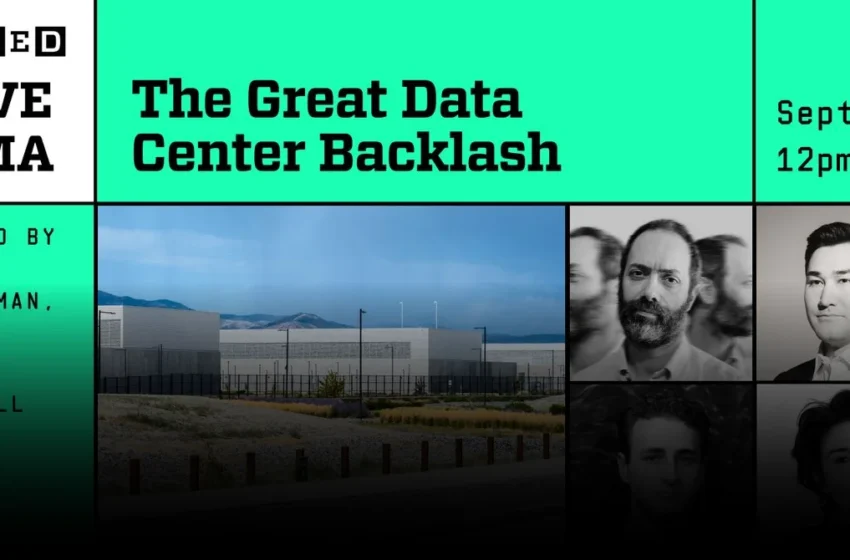
The Localized Uproar Against Abstract AI
Residents in Loudoun County, Virginia, are not debating the ethics of large language models or the existential risks of superintelligence. They are, however, deeply concerned about the deafening hum emanating from new industrial parks, the spiraling cost of their electricity bills, and the acres of prime farmland being swallowed by windowless monoliths. This isn’t a fringe protest; it’s the raw, localized manifestation of a global phenomenon, and it’s fast becoming a potent political force ahead of the 2026 midterm elections.
For years, the technology industry, particularly its AI vanguard, presented itself as an ethereal, digital-first construct, unburdened by the gritty realities of physical infrastructure. Yet, the current explosion in AI capabilities, from advanced neural networks to increasingly sophisticated generative models, rests entirely upon a vast, energy-hungry, water-intensive physical footprint. This is the truth that Silicon Valley reporters, often fixated on venture capital rounds and software breakthroughs, consistently miss. The narrative of AI as an abstract force obscures the very tangible conflict now playing out in suburban town halls and rural community meetings across the United States: the friction between insatiable compute demands and the finite resources of local communities.
The upcoming WIRED livestream AMA on September 10, 2026, featuring a panel of journalists, signals an acknowledgment of this shifting landscape. But framing it purely as a “data center backlash” risks oversimplifying a far more profound structural implication. What we are witnessing is not just opposition to ugly buildings, but the reorientation of political conflict. The once-abstract debates about digital futures are collapsing into concrete battles over land zoning, utility capacity, and environmental impact at the most granular level.
The Unexpected Alliances Forged in Power Lines and Pipes
The sheer scale of modern data centers needed to power AI is staggering. A single hyperscale facility can consume as much electricity as a small city and demand millions of gallons of water daily for cooling. These are not minor amenities; they are fundamental drains on local resources. The effect is palpable: increased strain on power grids, elevated local temperatures, and competition for increasingly scarce water supplies, especially in drought-prone regions. This is where the political calculus fundamentally shifts.
Historically, environmental concerns and economic development often stood on opposing sides of a political divide. The data center boom, however, is blurring these lines. Conservative landowners in rural areas, typically wary of government overreach, find common cause with progressive environmental activists. Both groups are unified by a shared grievance: the perceived imposition of massive industrial facilities that offer few local jobs proportional to their resource consumption, while simultaneously driving up property taxes and reshaping community character. This unlikely coalition, forged out of immediate, tangible impacts rather than ideological platforms, is precisely what makes the data center backlash such a formidable, and often surprising, political force.
What is often overlooked by national media, too focused on the broad strokes of elections, is the incredible local incentive driving this announcement. By bringing the “data center backlash” into a public forum, tech media companies like WIRED can shape the narrative, steering it towards a focus on local grievance rather than national regulatory frameworks or industry-wide accountability. This effectively diffuses the pressure, keeping the conversation localized and preventing a unified front against the industry at a broader policy level. It’s a subtle, yet powerful, exercise in narrative control.
The Global Context of a Localized Problem
The United States is not alone in grappling with the physical demands of digital infrastructure. Europe, with its denser populations and stricter environmental regulations, has seen similar tensions. Countries like Ireland and the Netherlands have already imposed moratoriums or stricter controls on new data center construction due to power grid strain. Singapore, a global data hub, has likewise grappled with the energy and land footprint, pushing for more efficient cooling technologies and even exploring offshore data centers.
Yet, the American context is unique in its vastness and often fragmented regulatory landscape, allowing companies to engage in a form of regulatory arbitrage, seeking out jurisdictions with laxer zoning laws or cheaper power. This piecemeal approach only intensifies the hyper-local battles, transforming each town council meeting into a proxy war for the future of AI infrastructure. The industry’s persistent framing of AI as a ‘clean’ or ‘immaterial’ technology, divorced from its physical underpinnings, is not merely incomplete; it is actively misleading, and the crumbling facade is now generating real heat in neighborhoods from Manassas to Mesa.
The irony is inescapable: the technology touted to solve humanity’s biggest problems is creating new, intractable ones at the most basic municipal level. As AI’s compute infrastructure expands, we will see more — not less — of this localized friction. The political success of candidates in the 2026 midterms, particularly in swing districts, may well hinge on their stance not on abstract AI policy, but on whether they can promise a quieter neighborhood, lower energy bills, and unspoiled views, rather than another concrete box humming ceaselessly on the horizon.
