
The Convenient Fable: How Blaming China Obscures America’s Data Center Reckoning
- Artificial Intelligence
Arjun Vedanta
- 0
- 6 minutes read
The Homegrown Resistance That Silicon Valley Ignores
American sentiment towards data centers has curdled dramatically, with 75 percent of the public now opposing their construction in local areas—a near doubling from just last year. This widespread domestic discontent, however, is being conveniently reframed by prominent tech leaders and their political allies as the insidious work of foreign adversaries, specifically China.
This narrative, despite its pervasive amplification, crumbles under even casual scrutiny. Reports circulating in Washington D.C., purporting to detail Chinese interference, are repeatedly described by experts as thin on evidence, leaning instead on inference and assumption. When OpenAI, one of the entities making such claims, banned a cluster of users linked to the Chinese government, it simultaneously conceded that these accounts were merely “exploiting existing discontent around AI infrastructure.” More recently, X reported identifying 200 accounts linked to China spreading anti-data center talking points. Yet, these 200 accounts were a mere fraction of a 200,000-account bot farm, hardly the smoking gun of a sophisticated geopolitical campaign to sway American public opinion on local zoning.
The consensus among impartial observers remains unchanged: the vast majority of opposition to hyperscale data centers is authentically homegrown. Tyler Williams, vice president of intelligence at social media analytics firm Graphika, observed earlier this year, and reiterates now, that there is “very little evidence of significant foreign intervention.” This inconvenient truth exposes the China narrative for what it is: a calculated deflection. The idea that a vast, sophisticated nation-state actor would bother subtly undermining public opinion on data centers in the US, rather than directly attacking critical infrastructure or stealing IP, suggests a remarkable misreading of geopolitical strategy or, more likely, a convenient narrative for a domestic crisis.
The Geopolitical Smokescreen: Incentives and the Blame Game
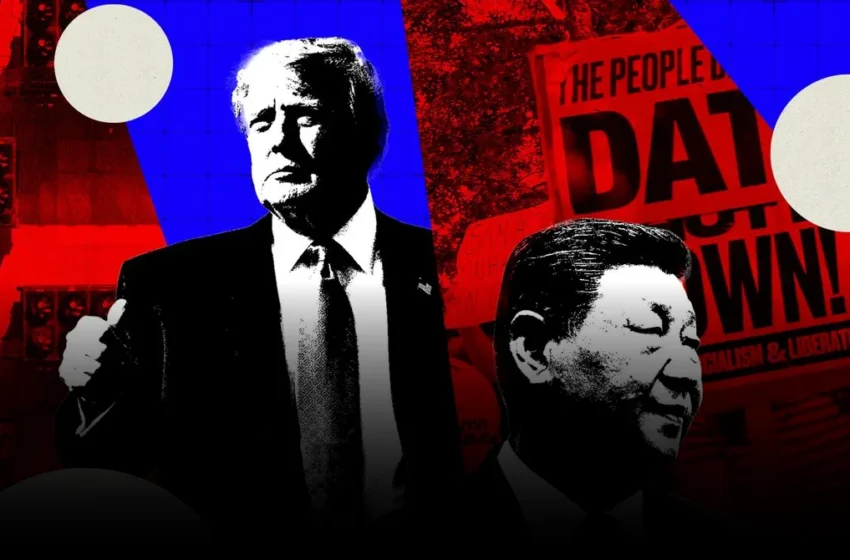
The timing of this blame game is no accident. As midterm elections approach, politicians like Texas Governor Greg Abbott and Pennsylvania Governor Josh Shapiro, once data center advocates, are now scrambling to adopt a tougher stance to appease voters. This shift forces tech companies and their staunch supporters, including former President Donald Trump, to find a compelling counter-narrative for their continued push for massive infrastructure. President Trump himself, in a Truth Social post defending data centers, declared, “China could not be happier with this anti Data Center movement,” echoing the precise sentiment that conveniently explains away local resistance.
This announcement and the subsequent amplification of China-blaming serve a clear purpose: to discredit genuine environmental and social concerns as foreign-orchestrated propaganda, thus preserving political will and financial investment for massive, unpopular infrastructure projects that disproportionately benefit a few powerful tech conglomerates. Blogger Andy Masley, who himself is pro-data center, notes the immediate shift in conversation when the topic of China arises among tech boosters: “as soon as I start talking China, they get quiet,” he recounts, suggesting it’s “a very convenient belief.”
The argument itself is fraught with logical inconsistency. At one end, officials within the Trump administration complain that Chinese firms are stealing American advances in AI. At the other, they imply China is actively sabotaging the very infrastructure necessary for AI development within the US. As my colleague Louise Matsakis, a senior business editor and China expert at WIRED, points out, panics like these often “belie a basic misunderstanding of what Chinese influence campaigns actually look like.” She adds, critically, that “Americans often find it easier to put the blame on a nebulous other, rather than to actually look at themselves.” This mirrors a long-standing pattern in US politics, where external bogeymen are conjured to distract from internal policy failings or unpopular economic realities.
Automation’s Unseen Toll: Beyond the Server Racks
The real story of data center opposition lies not in Beijing, but in the tangible and often negative impacts on American communities and their energy grid. These facilities are voracious consumers of land, water, and electricity, putting immense strain on local resources and existing infrastructure. While often framed as job creators, the reality is more complex. Data centers, increasingly automated, employ far fewer people than their physical footprint might suggest, particularly as tasks like facility maintenance become streamlined.
As Paresh Dave, another WIRED colleague, recently highlighted in his reporting on Meta’s push for a robot workforce in data centers, the automation extends beyond technical roles to even support staff. “It’s important to realize that as data centers automate some of the more technical work and reduce on-site jobs, operators could also save money on items such as food and janitorial services—and all those people would also be losing work.” This economic displacement, alongside pressure on the local energy grid, is what fuels genuine outrage, not fabricated foreign influence campaigns.
Indeed, the broader economic impact of the AI boom is only beginning to be understood. Texas, a state with numerous data centers in development, is already experiencing high unemployment rates among recent college graduates, a trend linked to AI’s rapid ascendance. This is not a China problem; it’s a structural labor market issue. Meanwhile, at a hyper-local level, the pushback is palpable and often aggressive. In Arkansas, Entergy controversially sought a restraining order against a newspaper for publishing details of a data center deal with Google, even dragging a young mother who made the original records request into court. These are the battles being fought on the ground, battles over transparency, land use, and digital sovereignty. The flurry of state legislation around data centers heading into the 2026-2027 legislative year underscores that this issue is firmly a domestic policy challenge, not a geopolitical skirmish. The China narrative, therefore, serves less as a credible explanation and more as a convenient, if cynical, mechanism for tech and political elites to avoid accountability for the very real, often destructive, consequences of their relentless push for AI infrastructure.
