
Martian Cloud Physics: How ‘Exotic’ Discoveries Redefine Earth’s Climate Models
- Space
Arjun Vedanta
- 0
- 10 minutes read
Martian Cloud Physics: How ‘Exotic’ Discoveries Redefine Earth’s Climate Models
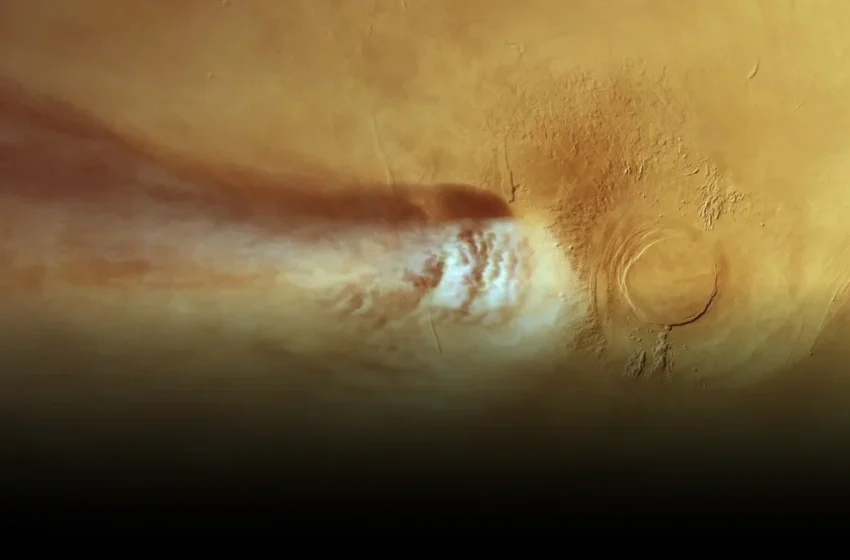
The perplexing 1,000-mile (1,609 km) cloud near Mars’ Arsia Mons volcano, long a mystery, has finally been successfully modeled by researchers, revealing "exotic physics" previously confined to theoretical textbooks. This groundbreaking discovery offers profound implications for US atmospheric science, potentially validating sophisticated climate models and refining predictions for extreme weather events on Earth by showcasing physics thought impossible in natural settings.
For years, the Arsia Mons Elongated Cloud (AMEC) has appeared and dissipated daily during Martian spring and summer, stretching a distance comparable to flying from New York City to Kansas City. Since its first recorded observation in 2018, its consistent, inexplicable behavior has challenged planetary scientists, including those at NASA and various US universities, who have grappled with its origins. The recent breakthrough from Sorbonne Université’s Jorge Hernández-Bernal and his team doesn’t just explain AMEC; it unveils a new realm of atmospheric physics with direct relevance to how American researchers approach complex climate dynamics and severe weather patterns closer to home.
What is the Arsia Mons Elongated Cloud (AMEC) and Why Was It a Mystery?
The Arsia Mons Elongated Cloud (AMEC) is a singular meteorological phenomenon on Mars. Every morning during the Martian spring and summer, this wispy formation emerges near the Tharsis region’s Arsia Mons volcano. It gradually elongates, reaching an impressive span of over 1,000 miles (1,609 km) before dissipating later in the day, a cycle that repeats for several months. First detected by a probe in 2018, the cloud’s consistent, almost clockwork-like appearance and disappearance defied conventional atmospheric explanations.
Scientists, including those funded by US agencies like NASA, have struggled to model AMEC’s behavior using established atmospheric physics. Its sheer size, daily recurrence, and precise positioning around the volcano posed significant challenges. The inability to reconcile observed Martian cloud formations with existing theoretical frameworks created a gap in our understanding of planetary atmospheric dynamics, making AMEC not just an anomaly, but a critical puzzle for space exploration.
Unveiling "Exotic Physics": How Mars Challenges Terrestrial Assumptions
The breakthrough in understanding AMEC came when Jorge Hernández-Bernal, a planetary scientist at Paris’ Sorbonne Université and lead author of the study, and his team incorporated what he described as "exotic physics" into their simulations. Hernández-Bernal noted in a press release that these are "physics that, while included in textbooks, is treated as theoretical and usually thought not to happen in nature. It certainly hasn’t been seen in action before." Once these previously theoretical principles were included, the AMEC emerged in their models "just as we hoped.”
This means the physical processes driving AMEC are not the standard atmospheric dynamics of condensation, convection, and advection typically observed on Earth or even other parts of Mars. Instead, the Martian atmosphere, with its unique density, pressure, and temperature profiles, appears to be an active laboratory for validating physics once considered purely academic. The specific mechanisms weren’t detailed in the source, but the implication is clear: fundamental forces, perhaps related to complex non-equilibrium thermodynamics or unique fluid dynamics under extremely thin atmospheric conditions, are at play.
The validation of these theoretical concepts through Martian observation opens new avenues for atmospheric modeling across the cosmos, fundamentally altering our perception of what is physically possible. It challenges scientists to reconsider whether similar, albeit perhaps less dramatic, "exotic" phenomena could be at work in other planetary atmospheres, including, in subtle ways, our own.
Implications for Earth: Refining Climate Models and Weather Prediction
The discovery that "exotic physics" can manifest naturally in a planetary atmosphere has profound implications for Earth-based atmospheric science. For US agencies like the National Oceanic and Atmospheric Administration (NOAA) and research institutions deeply invested in climate modeling, this revelation could be a game-changer. Our current climate models, while highly sophisticated, are built upon observable and empirically validated physical principles.
The Martian finding suggests that some of the subtle, yet powerful, forces at play in our own atmosphere might be better understood by incorporating these once-theoretical physics. This doesn’t necessarily mean Earth is experiencing 1,000-mile clouds driven by the same exact mechanisms. Instead, it prompts a critical re-evaluation of the underlying physics within our models, particularly in extreme or localized conditions where current predictions sometimes fall short. For instance, in complex phenomena like severe thunderstorms, hurricane intensification, or the intricate dynamics of polar vortices, very specific energy transfers or fluid behaviors could be influenced by these "exotic" principles.
Comparative planetology, the study of other planets to understand Earth, gains immense value here. By observing the consequences of these physics on Mars, American scientists can gain new insights into refining their models, potentially improving the accuracy of long-term climate projections and short-term severe weather forecasts. This is particularly crucial for regions vulnerable to escalating climate impacts, enabling better preparedness and resource allocation across the United States.
Comparing Atmospheric Modeling Approaches
| Aspect | Traditional Earth Models | New Martian Insights | Potential Impact on Earth Models |
|---|---|---|---|
| Underlying Physics | Mainly observed, empirically validated principles | Validation of previously theoretical "exotic physics" | Refine physics engines for higher accuracy |
| Cloud Formation | Primarily condensation, convection, advection | Suggests additional, non-traditional mechanisms | Improved microphysics in cloud parameterizations |
| Fluid Dynamics | Standard Navier-Stokes equations | Indicates need to consider complex, non-linear terms | Enhanced simulation of turbulent flows, extreme events |
| Energy Transfer | Radiative forcing, latent heat, sensible heat | Reveals previously unobserved energy pathways | Better understanding of complex feedback loops |
The Future of Martian Exploration and US Scientific Leadership
This scientific breakthrough underscores the continuing importance of deep space exploration, particularly for missions led by US institutions. NASA’s fleet of orbiters, landers, and rovers on and around Mars—such as the Mars Reconnaissance Orbiter (MRO) which first recorded AMEC, and future missions like the Mars Sample Return program—are instrumental in gathering the data necessary for such discoveries. The ability to model and understand phenomena like AMEC informs the design of future instruments, potentially leading to targeted observations that can further elucidate these "exotic physics."
The collaboration between US researchers and international partners, exemplified by Sorbonne Université’s work, is crucial. It ensures a global pool of expertise is brought to bear on complex challenges, benefiting all. By continually pushing the boundaries of what we understand about other planets, the US maintains its leadership in space science and inspires the next generation of American engineers and scientists to pursue careers in STEM, ensuring a robust talent pipeline for future innovations.
Furthermore, understanding Martian atmospheric dynamics is critical for future human missions. Predicting weather patterns, dust storms, and atmospheric conditions will be vital for astronaut safety and mission success. The knowledge gained from AMEC directly contributes to building a more comprehensive picture of the Martian environment, optimizing landing sites, and designing durable habitats and vehicles for sustained presence on the Red Planet.
This research highlights that even seemingly distant planetary phenomena can hold keys to understanding our own world better. The insights gleaned from a distant Martian cloud could very well contribute to more resilient communities and more precise climate mitigation strategies across the United States.
Key Takeaways
- The Arsia Mons Elongated Cloud (AMEC) on Mars, a 1,000-mile (1,609 km) long seasonal cloud, has finally been successfully modeled by researchers.
- Its formation is driven by "exotic physics" previously considered theoretical and never directly observed in nature, according to lead researcher Jorge Hernández-Bernal.
- This discovery validates fundamental physics that can refine Earth’s atmospheric and climate models, potentially improving predictions for extreme weather events.
- Studying Martian atmospheric dynamics through comparative planetology offers new perspectives for US climate science and future space mission planning.
- The findings emphasize the critical role of international scientific collaboration and continued investment in planetary exploration.
FAQ
What is the Arsia Mons Elongated Cloud (AMEC)?
The AMEC is a recurrent cloud on Mars that forms daily during the planet’s spring and summer near the Arsia Mons volcano, stretching over 1,000 miles (1,609 km) before dissipating each day. It was first observed by a probe in 2018.
What "exotic physics" is involved in AMEC’s formation?
Researchers found that modeling AMEC’s formation required incorporating specific theoretical physics principles not typically observed in natural planetary atmospheres. While detailed mechanisms weren’t specified in the source, these are processes usually confined to textbooks, now validated by Martian observation.
How does this discovery impact our understanding of Earth’s atmosphere?
This validation of theoretical physics through Martian observation could significantly refine Earth’s atmospheric and climate models. It suggests that similar, perhaps more subtle, ‘exotic’ phenomena might influence extreme weather events or long-term climate dynamics on our own planet, improving predictive capabilities for US agencies like NOAA.
What’s next for Mars atmospheric research?
The discovery will likely spur further computational modeling and targeted observations by missions like those from NASA. Researchers will seek to confirm the specifics of these "exotic physics" and explore their presence in other Martian atmospheric phenomena or even on other planets, advancing comparative planetology.
