
Neanderthal Woodworking Rewrites History: Spain Discovery Challenges ‘Dumber Cousin’ Myth
- Tech
Arjun Vedanta
- 0
- 10 minutes read
Neanderthal Woodworking Rewrites History: Spain Discovery Challenges ‘Dumber Cousin’ Myth
The groundbreaking discovery of 597 exceptionally preserved wooden tools at Abric Romaní in Spain dramatically reshapes our understanding of Neanderthal technological sophistication, demonstrating their advanced woodworking skills and definitively challenging the outdated perception of them as less intelligent than Homo sapiens. This immense trove, dating from 62,000 to 40,000 years ago, reveals a complex toolkit far beyond simple hunting implements, suggesting a level of planning and craftsmanship previously underestimated by the scientific community. For American tech enthusiasts and those invested in the narrative of human ingenuity, this find isn’t merely an archaeological footnote; it highlights how technological innovation, even in the Stone Age, directly reflects profound cognitive capacity and adaptability, prompting a necessary reevaluation of our own evolutionary journey.
For too long, the image of Neanderthals has been tarnished by a stereotype of brute force and limited intellect, often portrayed as a less capable evolutionary dead end compared to anatomically modern humans. This perception was largely fueled by the scarcity of evidence regarding their material culture, particularly organic tools. Unlike stone, wood rapidly degrades over tens of thousands of years, leaving vast gaps in our understanding of Paleolithic life. Early findings of wooden artifacts, such as spears from Schöningen, Germany, or Clacton-on-Sea in England, were rare exceptions, preserved primarily in oxygen-deprived, waterlogged sediments. Such limited data inevitably led to an incomplete, and often reductive, picture of Neanderthal capabilities.
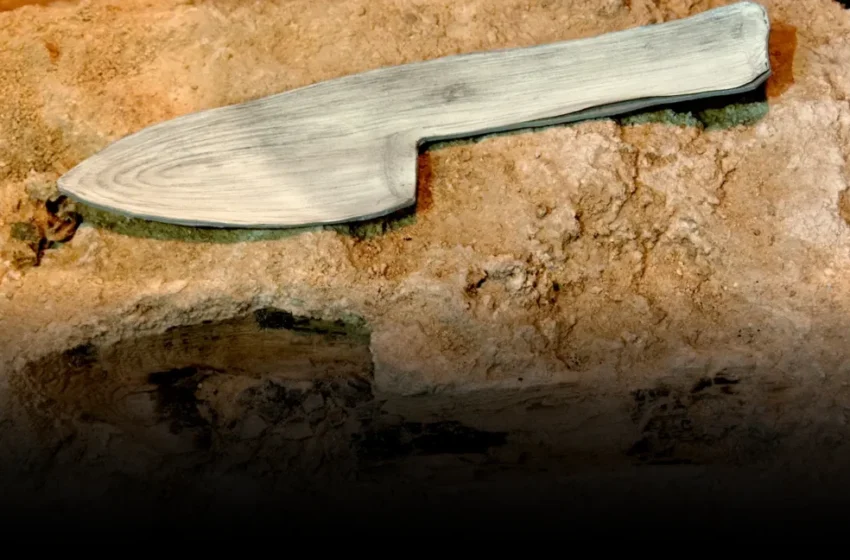
The excavation at Abric Romaní, a rock shelter in Capellades, west of Barcelona, provides an unparalleled window into this lost world of Neanderthal technology. Here, a unique natural process occurred: mineral-rich water continually flowed through the shelter, encasing wooden tools in a limestone-like crust. As the wood eventually decayed, it left behind perfect, hollow molds, faithfully capturing the shape, dimensions, and even surface textures of the original artifacts. These “fossilized shadows” are now being meticulously studied by a team of Spanish archaeologists, whose findings were recently published in Science Advances.
Unearthing a Lost Chapter of Neanderthal Technology
The scale and diversity of the Abric Romaní collection are what truly set it apart. Comprising nearly 600 individual wooden remains, the site offers the most comprehensive look yet at the woodworking skills of our ancient cousins. Far from a handful of isolated weapons, the collection includes a wide array of implements essential for daily survival and cultural practices.
- Spears: Evidence of hunting prowess, crafted with precision for piercing and thrusting.
- Digging Sticks: Tools likely used for foraging roots and tubers, demonstrating a sophisticated understanding of plant resources.
- Bark Trays: Suggesting methods for collecting, carrying, or even processing food and other materials.
- Parts of Shelters: Indicating systematic construction and an ability to create more permanent or semi-permanent dwellings.
- A Unique Club: An implement unlike any previously identified, hinting at specialized functions or innovative designs.
This diverse toolkit paints a picture of a species deeply engaged with its environment, utilizing wood not just for hunting, but for a broad spectrum of activities including food procurement, material transport, and structural engineering. The sheer variety implies a highly adaptable hominid, capable of manufacturing tools tailored for specific purposes, a hallmark of advanced technological development.
What Does Advanced Woodworking Reveal About Neanderthal Minds?
The implications of this sophisticated Neanderthal technology extend far beyond their practical utility; they offer profound insights into the cognitive capabilities of these early humans. Crafting a wooden tool, especially one requiring specific shapes and functions, demands a complex set of mental processes:
- Abstract Planning: Envisioning the final form of a tool from a raw piece of wood, requiring foresight and mental manipulation of shapes.
- Skilled Execution: The ability to select appropriate wood, then use other tools (likely stone or bone) to carve, scrape, and smooth, demonstrating fine motor control and learned expertise.
- Problem-Solving: Designing and adapting tools to meet specific environmental challenges or subsistence needs, such as a digging stick optimized for certain soil types.
- Material Knowledge: Understanding the properties of different woods – their strength, flexibility, and suitability for various tasks.
The presence of items like bark trays and shelter components strongly suggests a level of organization and perhaps even a division of labor within Neanderthal groups. Constructing a shelter, for instance, requires collaborative effort and a shared understanding of design principles. The “unique club” further underscores their capacity for innovation, moving beyond established forms to create novel implements.
This evidence significantly narrows the perceived cognitive gap between Neanderthals and early Homo sapiens. It suggests parallel evolutionary trajectories in technological innovation, rather than a linear progression where modern humans were the sole pioneers of complex thought and toolmaking. The notion that Neanderthals were merely “dumber cousins” becomes increasingly untenable in the face of such compelling archaeological data.
Redrawing the Evolutionary Tree: Implications for Understanding Early Human Innovation
For American science education and the broader public, the Abric Romaní findings necessitate a significant update to how we perceive human evolution. The long-standing narrative often places Homo sapiens at the pinnacle of intelligence and innovation, with Neanderthals relegated to a secondary, less evolved role. This discovery forces us to acknowledge a more complex, nuanced reality.
It highlights that technological progress isn’t solely the domain of one hominid lineage. Neanderthals were innovators in their own right, adapting their tool-making strategies to the available resources and environmental pressures. Their mastery of woodworking, revealed through these artifacts, suggests a deep understanding of natural materials and engineering principles, capabilities that directly contributed to their survival and cultural development across Europe and Asia.
The impact of this research is substantial for fields like paleoanthropology and cognitive archaeology. It provides tangible evidence that complex behaviors, often attributed exclusively to modern humans, were present much earlier and in other hominid species. This expanded view enriches our understanding of the diverse paths early hominids took in developing intelligence, social structures, and adaptive technologies. It underscores that the story of human innovation is far richer and more intricate than previously assumed.
The Abric Romaní Advantage: Why This Site is Unique
The singular conditions at Abric Romaní, where mineral precipitation acted as a natural preservation agent, allowed these ephemeral wooden tools to endure. This unique geological setup is a rare stroke of luck, as wooden artifacts typically require waterlogged, anaerobic environments (like those found at Schöningen) to resist decay. The insight gained from this site is invaluable, serving as a powerful reminder that much of ancient life remains hidden, waiting for the right conditions—or the right investigative techniques—to be revealed. It challenges archaeologists to reconsider what might be missing from the fossil record and to develop new methods for detecting organic remains.
The Abric Romaní discovery marks a pivotal moment in our understanding of Neanderthals, positioning them not as intellectually inferior predecessors, but as capable, intelligent innovators who mastered their environment with sophisticated Neanderthal technology. This evidence reshapes our evolutionary narrative, emphasizing the diverse ingenuity present among early human species.
Key Takeaways for TechTicle Readers:
- Neanderthals possessed a diverse and sophisticated woodworking toolkit, including spears, digging sticks, bark trays, and shelter components.
- This level of craftsmanship and tool diversity challenges the long-held stereotype of Neanderthals as less intelligent or technologically primitive compared to Homo sapiens.
- The discovery at Abric Romaní in Spain provides critical evidence for advanced cognitive abilities in Neanderthals, such as planning, problem-solving, and material knowledge.
- Unique preservation methods, like the limestone molds at Abric Romaní, are essential for revealing the full scope of ancient organic technologies often lost to decay.
- The findings necessitate a reevaluation of our understanding of early human innovation, highlighting the complex and multifaceted paths of technological and cognitive development among hominids.
Frequently Asked Questions About Neanderthal Technology
What kind of wooden tools were found at Abric Romaní?
Archaeologists at Abric Romaní in Spain discovered a wide range of Neanderthal wooden tools, including spears for hunting, digging sticks for foraging, bark trays for carrying or processing materials, parts of shelters indicating construction capabilities, and a uniquely designed club. This collection of 597 items showcases a remarkably diverse toolkit.
How were these ancient wooden tools preserved for so long?
The wooden tools at Abric Romaní were preserved due to a unique geological process. Mineral-rich water flowing through the rock shelter encased the organic materials in a limestone-like crust. Over tens of thousands of years, as the wood decayed, it left behind precise hollow molds within this mineral crust, faithfully retaining the original shape of the tools.
What do these new findings tell us about Neanderthal intelligence?
The sophisticated and diverse wooden tools found at Abric Romaní strongly suggest that Neanderthals possessed advanced cognitive abilities, including abstract planning, skilled craftsmanship, and complex problem-solving. This discovery challenges the outdated view of Neanderthals as intellectually inferior and highlights their capacity for innovation and adaptable technology, much like early Homo sapiens.
