
Russia’s Arena-M Tank Defense Stumbles Against Ukraine’s Drone Swarms
- Military Technology
Arjun Vedanta
- 0
- 5 minutes read
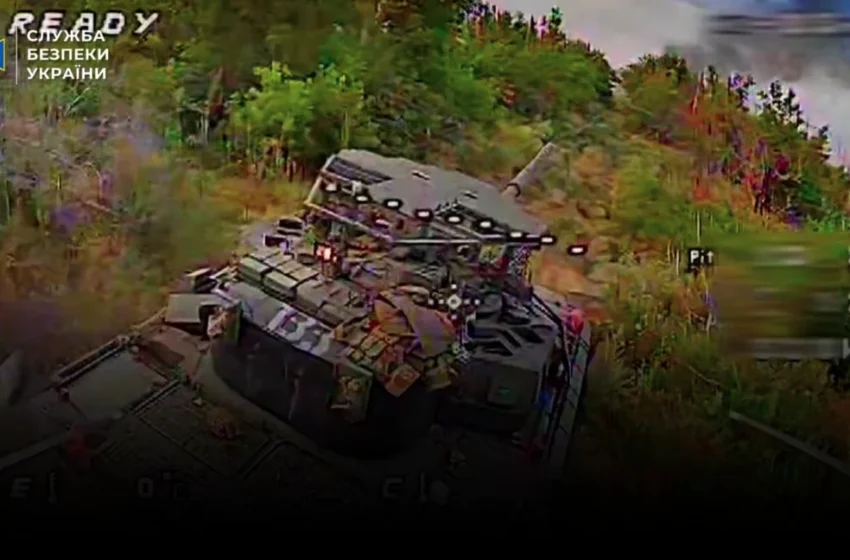
It’s easy to focus on the flashy technology, the latest active protection system, the headline-grabbing countermeasure. But the true story unfolding in Ukraine, evidenced by the recent combat debut of Russia’s Arena-M system, is not about technological sophistication in isolation; it’s about the brutal calculus of cost, scale, and attrition. A Russian company-size assault on July 22 in Donetsk Oblast saw T-72B3A tanks, some fitted with the much-anticipated Arena-M, pushed back by Ukrainian defenders. The footage confirms at least seven tanks destroyed, despite the new defensive gear attempting to bat drones out of the sky.
This outcome, where an advanced system like Arena-M — designed explicitly to shoot down incoming threats — can be overcome by sheer volume, should give every defense contractor pause. Ukrainian soldiers reported needing between 15 and 20 kamikaze drones to disable each tank. This isn’t a failure of the Arena-M’s underlying concept, but a stark illustration of how rapidly an asymmetrical conflict can shift the economic advantage.
The Scalability Fallacy in Modern Warfare
The Arena-M system, an evolution of earlier Soviet designs, reportedly shoots kinetic interceptors to destroy projectiles mid-air. It represents a significant investment, a complex integration of radar and weaponry intended to create a protective bubble around an armored vehicle. Its battlefield appearance was certainly a testing ground, confirming that some incoming drones were indeed neutralized, as reported by journalists Dmytro Putiata and Rob Lee.
Yet, this partial success is overshadowed by the system’s fundamental vulnerability to swarm tactics. Each interceptor fired by Arena-M is likely expensive, sophisticated, and finite. When faced with 15 or 20 commodity drones, each costing perhaps a few thousand dollars, the economic exchange rate turns disastrously against the defender. This isn’t just about Ukraine; it’s a structural implication for any nation relying on high-tech, low-volume defensive countermeasures against mass-produced, low-cost offensive tools.
Beyond the Kinetic Kill: The Economic Battlefield
This isn’t merely a tactical setback; it’s a profound strategic challenge to traditional military procurement and doctrine. The military industrial complex, globally, is predicated on selling increasingly advanced, increasingly expensive hardware. A tank, even a T-72B3A, represents millions of dollars of investment. An active protection system adds hundreds of thousands, if not millions, more to that price tag.
When a few hundred thousand dollars worth of cheap, off-the-shelf drone technology can negate a multi-million dollar asset, the entire incentive structure for defense spending comes into question. The persistent drive towards more complex, higher-fidelity solutions often overlooks the strategic advantage of overwhelming, distributed, and economically viable threats. It forces a re-evaluation of what “superiority” even means on a modern battlefield where AI-assisted drone swarms become the new artillery.
The pronouncements from defense manufacturers and military analysts often lean into the narrative of technological breakthroughs, celebrating the ingenuity behind systems like Arena-M. However, it is precisely this framing that obfuscates the deeper truth: the actual “game-changer” isn’t a single, exquisite piece of hardware but the distributed, adaptable, and remarkably cheap nature of its adversary. This is why the announcement of Arena-M’s deployment, even with its mixed results, still served a purpose — it allowed the Russian state to project an image of advancing its defensive capabilities, a narrative that benefits both internal morale and the military-industrial sales pipeline, regardless of the system’s ultimate efficacy against sheer volume.
The Unseen Arms Race: Adaptation and Mass
The real arms race today is less about individual weapon performance and more about the speed of adaptation and the economics of mass production. While Western militaries debate the integration of complex counter-drone warfare systems, Ukraine is demonstrating that rapid, distributed innovation with commercial technology can outpace dedicated military R&D. The lessons here extend beyond armored vehicles to naval assets, air defenses, and even ground infantry.
What Silicon Valley reporters, often fixated on the next venture-backed unicorn, tend to miss is that the most impactful technological shifts aren’t always birthed in polished labs. They frequently emerge from the grim crucible of real-world conflict, driven by urgent necessity and the brutal constraint of limited resources. The current Ukrainian experience, where simple drones are continuously iterated, upgraded, and deployed in overwhelming numbers, presents a blueprint for future asymmetrical conflict that few conventional militaries are truly prepared for. It’s a sobering reminder that innovation without economic viability and mass scalability is often just an expensive sideshow on the battlefield.
